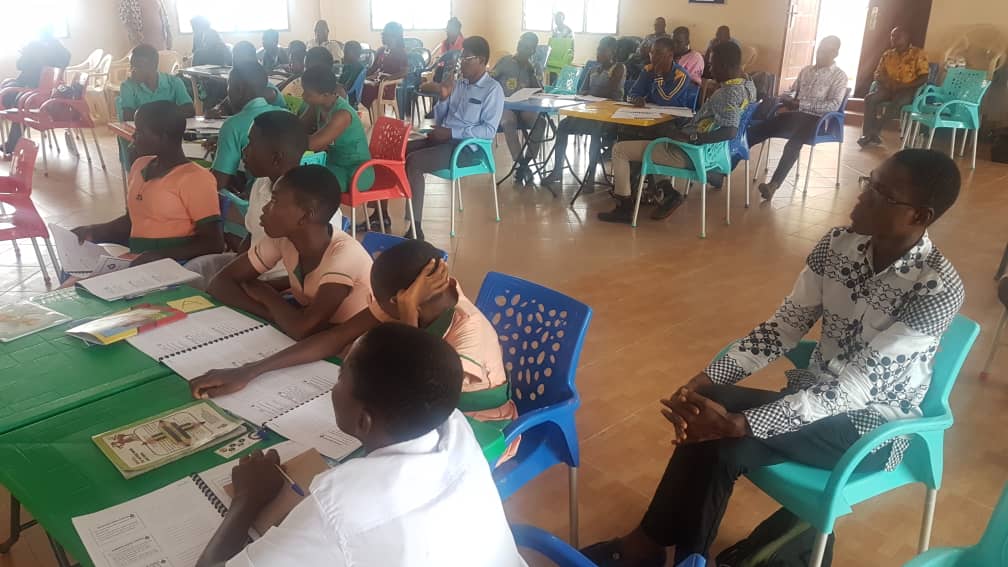
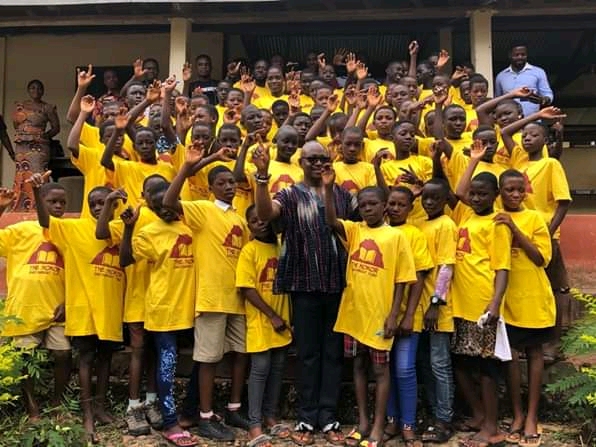
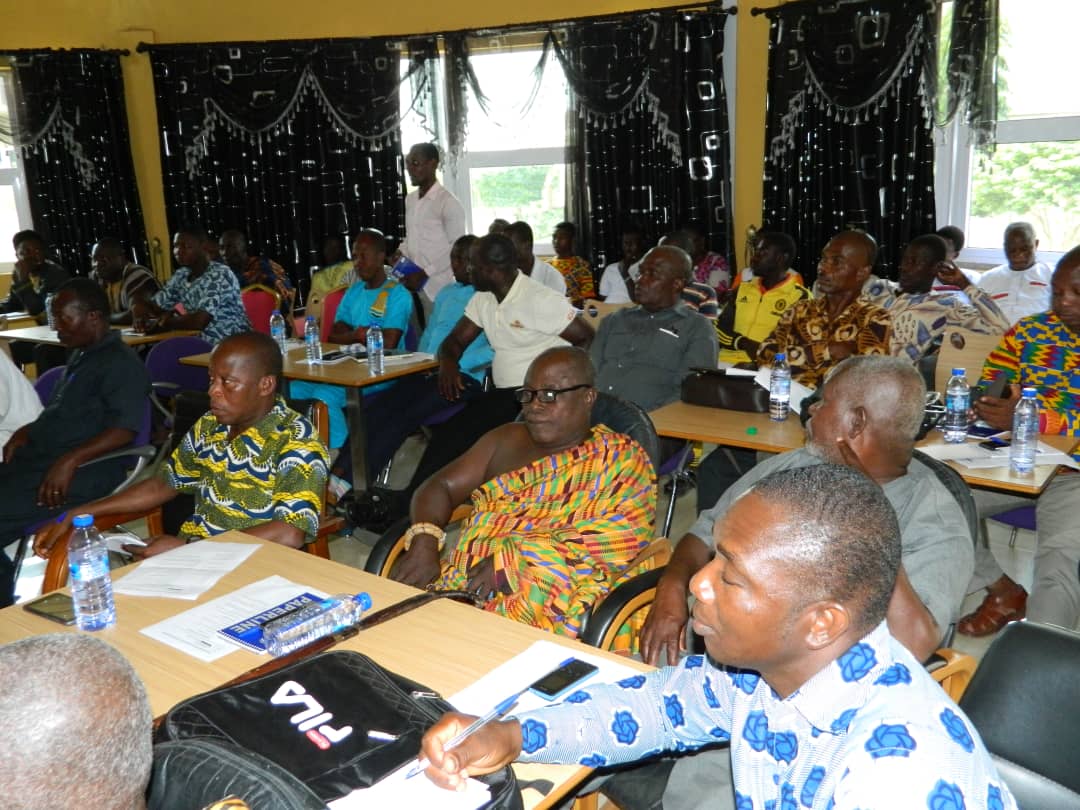
The Volta Regional department of Domestic Violence and Victim Support Unit (DOVVSU) of the Ghana Police Service has organised a day’s sensitisation programme to recruit schoolchildren as watchdogs in their various schools and communities in the fight against Sexual and Gender Based Violence (SGBV).
The programme held on Wednesday, September 18 at Tsito, Ho West District in the Volta Region which drew about 42 pupils from various basic schools and students from two second cycle institutions in Afadzato South District as participants, got funding support from the United Nations Population Fund (UNFPA).
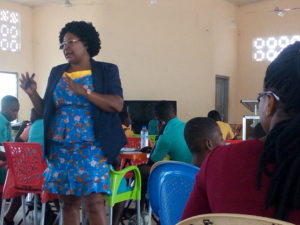
The Regional Coordinator, DOVVSU, Chief Supt Mercy Wilson-Brown in a presentation on protection and welfare of the child in domestic and other related violence, educated participants on what constitute abuses and the various Acts that protect the interests of a child.
Chief Supt Wilson-Brown who spent considerable time on SGBV including rape, defilement, incest, and child marriage, tasked participants to monitor changes such as truancy, moodiness, sitting posture, worry among others in their peers in school and report early to avert disaster.
“We should not wait until it confuses us. Let’s be watchdogs in our schools and identify such situations and call the attention of teachers.”
Chief Supt Wilson-Brown addressing participants
She cited the infamous kidnapping of the Takoradi girls recently confirmed murdered by the Police and crimes such as sextortion (committed over cyber space) as “things coming up which were hitherto not known to us” and called on pupils to beware of their environment and report unusual situations to teachers, parents, and the Police to help detect and prevent crimes.
She also cautioned adolescent girls especially, to stay away from sexual activities saying “sex is not for children, because it has dire consequences” while reminding the participants to “keep these things I’m telling you in your heart” for the good of society.
The in-charge, Regional Police Clinic, Ho, Dr. Emmanuel Amaglo called for concerted efforts to reduce cases of domestic violence saying, its effects could be damaging to the victim, the family community and the country at large.
Dr. Amaglo who broadly classified the effects of domestic violence into medical and socio-cultural, said it could lead to mental imbalance, permanent disability and even death (in the case of victims) and developmental challenges, social disorder and loss of human resource (in the case of the society).
Focal Person, UNFPA at the Volta Regional Coordinating Council (VRCC), Victoria Odurowa Fato who was at the programme for monitoring, explained that the Agency was running adolescent-targeted programmes in some selected districts in the region and having DOVVSU, National Youth Authority, Department of Gender and Ghana Health Service as sub implementing partners with VRCC playing supervisory role.
Also present at the programme were key stakeholders including representatives of traditional leaders, assembly members, driver unions and teachers from various districts with most of them expressing delight at the programme which they said was appropriate in the wake of increasing incidence of crime across the country.
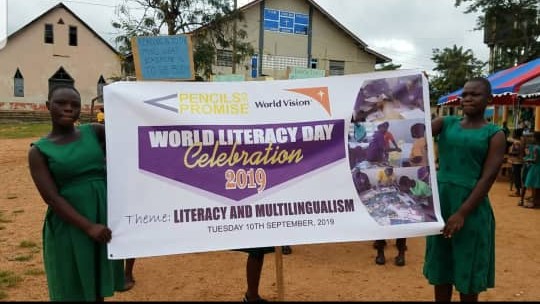
Pencils of Promise and World Vision has collaborated to celebrate this year’s International Literacy Day under the theme, “Literacy and Multilingualism” at Kadjebi in the Oti Region to draw people’s attention to the importance of multilingualism towards literacy.
Speaking at the event, Fred Parku who represented the Country Director of Pencils of Promise outlined the motive behind the celebration, which is promoting literacy and multilingualism worldwide, and charged parents to ensure that their wards speak their mother tongue as well as other languages.
The Nkwanta cluster manager of World Vision, Salomey Yeboah gave the importance of being multilingual.
Mrs. Yeboah disclosed that World Vision International in Ghana had invested close to US$1 million in the past seven years to support communities in the Kadjebi District with school infrastructure, training of teachers and providing teaching, learning and recreational materials, as well as water and sanitation facilities for schools.
The impact of these interventions included improved reading outcomes, improved water coverage for children, improvement in school enrolment, functional Parent Teacher Associations and School Management Committees among others.
According to her, many of the children in the district were at risk of competing at the knowledge market, because averagely only 1.63 per cent of primary two children in the district could read a grade level text (WVG-AMIC 2018) noting, it was for such a reason that Pencils of Promise and World Vision used the day to emphasise the need for all stakeholders to join hands to say no to illiteracy.
Okyeame Aseidu Kwesi Akyea of Kadjebi Traditional Area was optimistic that “if all subjects in our schools are being taught in our local languages, students would understand what they are being taught better.”
Okyeame Akyea finally appealed to the government to consider fixing into the school curriculum the use of Ghanaian languages to enhance education in the country.
Present at the event were schoolchildren from the various communities in the Oti Region, chiefs and elders of the land, the Kadjebi Education Director, a representative of the District Chief Executive, Pencils of Promise, World Vision and residents of the community and surrounding ones.
Three entities have made cash donations towards the 3rd Ghana Journalists Association (GJA)-Volta Region Awards.
Two of the companies, Zoomlion Ghana Ltd and Luggu Motors Ltd on Monday, September 16, handed separate cheques of GH¢3,000.00 and GH¢5,000.00 respectively to the leadership of GJA-Volta at the Press Centre in Ho, Volta Region capital.
Management of Luggu Motors registered the intention to scale up their support with additional GH¢5,000.00 later to make a total of GH¢10,000.00
Earlier last week, DW Akademie donated an amount of GH¢1,500.00 towards the Awards, which is slated for Saturday, October 5, 2019 at the plush Volta Serene Hotel.
The 2019 edition of the Awards which is on the theme “Environmental Cleanliness: Media as Vanguards. Don’t drop that litter”, will award deserving media practitioners in Volta/Oti Region in 11 categories including the newest addition, the coveted Overall Regional Journalist Award.
The 2019 Awards Committee Chairperson, a veteran journalist and former Dean of the Parliamentary Press Corps of Ghana, Rev. Ruby Amable during the launch some weeks ago, declared nominations open from Monday, August 26 to Friday, September 27, 2019 disclosing that only published works from November 1, 2018 to September 15, 2019 were eligible.
GJA-Volta in 2017, instituted and organised the country’s first ever regional awards programme to recognise and reward outstanding media practitioners based in Volta/Oti Region working in the print, electronic and online media so as to motivate them to do better.
It is commonplace to see children of school going age and women carrying water. The children normally do this early in the morning to get water for household chores and for bath to go to school. They also go carrying water after school. The women also do this for same reasons and more except to go to school after bathing the water.
Children go with buckets, young men shoulder yellow plastic jerry cans (Kuffour gallons), while women, metal bowls balanced on their heads with support from cloth pads. In most cases, these people walk long distances with few, lucky enough to have the “golden water” source close to them.
While this may be a normal practice for most families in various communities including Ghana’s capital, Accra to collect treated water from roadside pumps and tanks, those in Tonguland go through the trouble just for dirty water. Appalling because of the name the people carry. Tongu.
It is needless to mention the effects of the lack of potable water on the education of these children and the health of residents in these areas.
Tongu Explained
Tonguland is made up of three districts; South, Central and North Tongu in the Volta Region of Ghana. In the north, it shares borders with Eastern Region at (North Tongu), in the south (South Tongu), Greater Accra Region. At the centre (Central Tongu), it links the other Tongu areas, and Anloga and Akatsi districts to the regional capital, Ho through Adaklu District.
Tongu is an Ewe language which means, around the river, or riverine community. The area abounds with water bodies, River Volta, and streams with prominent ones being Chinni, Todzi, Aklakpa and Gbaga to the extent that most of the communities can only be accessed through crossing over tributaries of River Volta.
The Irony
In an area which has plentiful natural water resources, a large part of its population still does not have access to clean water and some of the citizens spend their income purchasing water, (not the clean one unfortunately) from private sellers. It is purely the case of lack in the midst of plenty.
Many communities in the Tongu area including Dorkploame, Agorgbe, Feyito, Alorwukope, Dadome, Kpogede, Kanuwloe, Fakpoe, Lasivenu, Fedakope, Anawoekope and Dorfor-Avegame do not have water.
Assembly member for Mafi-Fiekpe Electoral Area, Central Tongu District, Jerry Davor said residents of two communities in his area, Sorkope and Fedakope (one having Gbaga Stream which dries up during the dry season, the other, muddy pond) suffered to get water adding, in both cases, the residents shared their water sources with animals which remained one major health concern for him.
Mr. Davor noted that few residents who could afford, travelled distances to other parts of the electoral area to buy potable water with the poor majority resigning to their fate because no respite was in sight.
At Kpotame, a community about 10 kilometres away from the South Tongu District capital, Sogakope, same problem persists despite Ghana Water Company Limited (GWCL) pipelines running through the town.
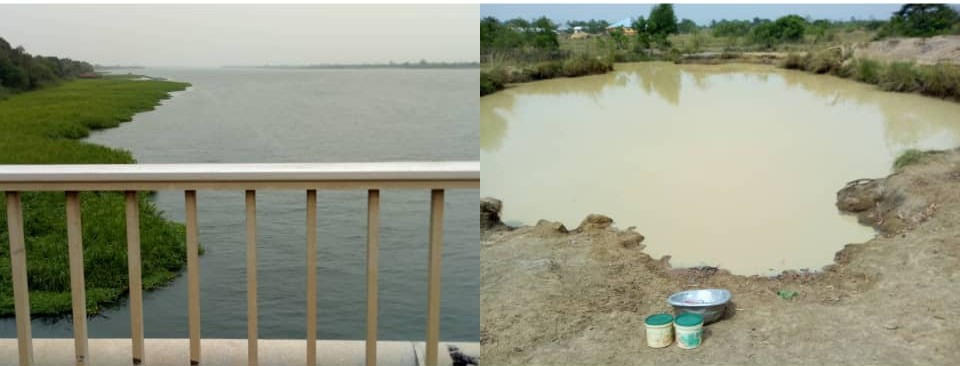
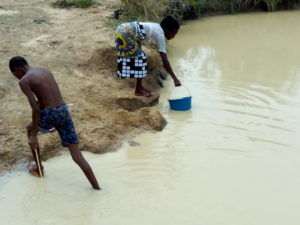
This has forced residents to resort to a nearby pond with dung of cows scattered all around requiring one to carefully look to avoid stepping on them, for water. Though the pond looks muddy on the surface, it reveals a dirty and brownish colour after it is scooped and stored in containers. Again, those who can afford, buy (but here) raw water from the Volta River from sellers in motorcycles.
Agnes Tofoh fetching water from a pond at Kpotame
A resident, Agnes Tofoh who gets water from this pond, said she sometimes used a chemical compound, potassium alum to purify the water for use and explained why she kept sharing water with cows and other animals.
“Buying water from these motorcycles is very expensive, one Kuffour gallon goes for GH¢1.00. Can you imagine how much I’ll spend in a day to take care of washing, cooking and other things for the family? To cut cost, the river water is only for drinking.”
Another resident, a nursing mother lamented the lack of potable water in the town and disclosed that she was at a point buying bags of treated water known as “pure water” from cars for her baby’s bath because both the water from the pond and the raw water from the motorcycles were causing irritation to the baby’s skin.
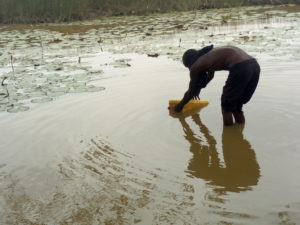
In a nearby community, Kasangblekpo, residents there get water from a dammed river, Kasangblekpo Dam. The dam has a greenish surface with lots of aquatic grasses on it.
A mother of five who gave her name only as Margaret said her children were always falling sick as a result of the water “which is contaminated with urine and faecal matter of animals” saying, on days she was not tired, she boiled the water before giving it to them.
According to her, she had no choice as she could not afford to buy the expensive river water (which is equally untreated).
Resident trying to get water from Kasangblekpo Dam
The Agitation
While some communities which are quite a distance from the major water source, Volta River may consider the situation their fate and only continue to hope it one day changes, others refuse to understand the failure of the state to provide them with clean water.
Residents of Kpotame, some kilometers away from the South Tongu District capital, Sogakope which is home to the Lower Volta Bridge, and shares boundary with Tojeh in the Dangbe East District of the Greater Accra say they do not understand why they should have problem with water.
Chairman of a youth group in the area, Concerned Youth of Tefle-Kpotame, Sam Moses said they had made several attempts to fix the decade-long problem including visiting the District Chief Executive, Emmanuel Louis Agama and his predecessors, the Member of Parliament (MP), Korbla Mensah Woyome with fail. Same old stories of plans being underway.
The Chairman said the group once organised Water Festival aimed at raising money to address the problem but the money realised was woefully inadequate and so, getting to the 2016 general elections, they planned to boycott the elections.
“We strategically erected the ‘No Water, No Vote’ signboard so that the then President John Mahama will know about our resolve and act. Indeed, he came and saw the signboard while returning from one of his campaign trips from Ketu South and promised that he would fix it. Today, he is a former President and that is it.”
“What pains me is that they say we’re in the Volta Region named after River/Lake Volta and in Tongu, people around the water yet we thirst for water. It is my wish that they carve Kpotame and its surrounding communities without water, from Volta and add to Greater Accra because in neighbouring Tojeh, there is water,” he fumed.
An elderly man at Kasangblekpo known only as Ametsitsia had this to say. “We’ve never had potable water here. They (authorities) came and lied to us that they were bringing pipe-borne water to us. Because we wanted the process fast-tracked and serve government cost, we organised ourselves, dug the hole for the pipelines to be laid.”
He lamented, “but there was no show and the hole remained till it got filled up over time. We even asked for the dam to be dredged but that too, no.”
Paramount Chief of Tefle Traditional Area and acting Chairman of Tongu Chiefs, Togbe Nakakpo Dugbaza VIII wondered why successive governments had deprived it citizens of such a basic necessity, “water which is life” insisting, “there’s a water company governed by statutes to provide that.”
Interventions
There were interventions. Recently, Rotrary Club of Ho in partnership with Rotary Club of Manchester commissioned a water project to provide potable water for the people of Fievie Dugame and its environs in the South Tongu District.
Volta River Authority some time ago, handed over a solar-powered mechanised borehole project to communities of Amlalokorpe, Klukorpe and Afagbakorpe in the North Tongu District.
Community Water and Sanitation Agency (CWSA) established by Act of Parliament in 1998 to facilitate the provision of safe drinking water to rural communities, which has an office in Central Tongu capital, Adidome, had provided water to a number of communities in the district.
Attempts had been made by MP for North Tongu, Samuel Okudzeto Ablakwa to sink boreholes in some communities in his constituency but the water from the boreholes could not be used because of the high salt content. Similarly, former President Jerry John Rawlings sunk a borehole at Kpotame Health Centre but that too is salty and not being used.
A non-governmental organisation, International Needs, Ghana installed rain water harvesting system and a reservoir in one of the communities but just as long spell of dry season dries up streams, residents cannot always rely on this system.
The Despair
Manager, Ghana Water Company Limited, Sogakope District, Osman Safianu clarified the issue with the Kpotame water and said, it was not about the company not being able to treat the abundant water from the river and supply to the people for consumption but the problem was about the pipelines in the town.
Mr. Safianu said the 6-inch (instead of 12) transmission line from Agordome Treatment Plant to Sogakope and the 2-inch (instead of 4) distribution pipeline to Kpotame rendered the pressure too low to get water to the community.
Then Chief Manager, GWCL, Volta Region, Joseph A. Nkrumah in reaction, explained that the expansion of the pipelines delayed because central government could not release funds of over GH¢1 million for work to start saying, the region had submitted estimates for that project and others across Volta/Oti Region for attention.
Ing. Nkrumah during this year’s World Water Day in March, acknowledged the financial problem facing the company established with the mandate of production and distribution of potable water to customers in urban areas of the country, which has made it after 54 years on, “still struggling to realise this dream.”
This he said would pose “serious challenge if the country has to meet the Sustainable Development Goal 6 (SDG 6)” which is about clean water and sanitation by 2030.
Volta Regional Director, CWSA, Divine Dugbartey agreed with Mr. Nkrumah citing financial challenge as impeding the Agency’s work of getting clean water to rural dwellers concluding that “it’s been a sad story for us in the water sector.”
Solution in the pipeline
DCE for South Tongu, Emmanuel Louis Agama disclosed that the assembly was in talks with an Indian company into banana production in the area pumping water from the river to irrigate its farms, connect a pipeline to Kpotame so residents could at least access the raw water as a temporary measure.
Mr. Agama was hopeful that with the onset of Sogakope-Lome Trans-boundary Water Supply Project which processes he said government was working on to acquire land for the construction of a raw water intake facility at Sogakope and water treatment plant, issues with water in the district and other parts of the region would be addressed.
For now, all the hope is in this project. While it is a good thing to have hopes, it is also necessary to note that even plans for this project have remained in the pipeline since 1970 due to lack of funds and technical challenges with recent feasibility studies done in 2005 (Mr. Kuffour’s era) and in 2015 (Mr. Mahama’s era) under the auspices of African Development Bank.
Perhaps, there must be hope this time because President Nana Addo Dankwa Akufo-Addo in his keynote address on September 7, 2017 following his appointment by UN Secretary-General to co-chair his group of Eminent Advocates for the 2030 Agenda for Sustainable Development, reconfirmed his government’s commitment to localising the SDGs in the country stressing, they could not be achieved through “business as usual.” Perhaps.
Ghana ranks lowest in sanitation levels among all lower middle-income countries, although richer than a lot.
That’s according to the United Nations International Children’s Emergency Fund (UNICEF) Chief of Water Sanitation and Hygiene (WASH), David Duncan.
He said the nation was one of the lowest in terms of access to sanitation worldwide and that it was rather ironic she sunk lower than countries recovering from wars.
Addressing municipal and district chief executives and other stakeholders at a meeting in Ho on the UNICEF WASH Program, Mr Duncan said funding was not the problem, “but commitment and prioritisation”.
He also revealed that thousands of children died from diarrhea and that the nation lost millions of dollars annually to poor sanitation and open defecation.
World Health Organization (WHO) a global watchdog on health defines sanitation as the provision of facilities and services for the safe disposal of human urine and faeces.
The word sanitation also refers to the maintenance of hygienic conditions, through services such as garbage collection and wastewater disposal.
In most parts of Ghana today, poor sanitation is increasingly becoming a huge problem and an embarrassment to Mother Ghana.
Sogakope, the district capital of South Tongu District is one of the main contributors to the nation’s poor sanitation status.
Sogakope is at a business transaction point for the district because it is a commercial centre located on the Ecowas road. Most women in the Sogakope Township sell bread, adodi, Tsofi, abolo (local foods) among others as their major businesses.
However, the administrative capital is faced with poor sanitation issues because of the attitude of residents in the town.
Sogakope market, a place where we buy our foodstuffs from has turned into a latrine and refuse dump for people living in Sogakope. So after market days, you do not know the difference between a dumping site and a market.
Most people in the town have refused to take a household dustbin citing their inability to pay the GH¢20 monthly dues for their refuse to be collected by the sanitation officers in town.
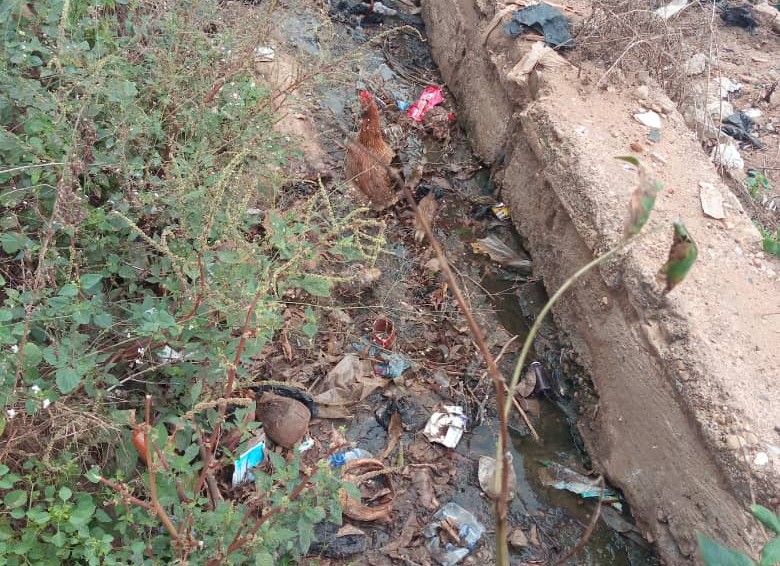
Again, most houses in the town are without toilets forcing tenants who cannot patronise the public toilets for various reasons, use gutters and surrounding bushes including Agorkpo R/C School Park as their toilet while throwing rubbishes around at undesignated places.
The result is that one gets to meet unpleasant smells at some important places in town especially from the gutters.
That is not all. Some people have also channeled their septic tanks into the drain and all these waste materials end up finding their ways into the River Volta and we still fetch water in the river for domestic use.
What is more, food vendors site their business points close to same places being used for refuse dumps without caring about anything and woe unto any ordinary person to complain. “My friend, mind your own business. Don’t you know that’s the work of Zoomlion? After all why is government paying them,” will be the reaction.
You might be wondering if indiscriminately littering is only done by uneducated persons but surprisingly, well dressed fully grown educated persons are not left out in littering of the environment. And they do this without any shame leaving one wondering what kind of mental state we are in as citizens of this nation.
Sources revealed that there is no garbage container for the people of Sogakope South Electoral Area where the market is located while the increased population has rendered two garbage containers at the Sogakope North and Central insufficient for the residents living around there to dump their refuse into.
It will not be surprising if the infamous Cholera outbreak that claimed lives of Ghanaians in 2014 would be a history repeating itself in Sogakope if we do not change our attitudes.
In case we have forgotten, the government is you and I which belongs to all of us so whatever we do whether good or bad, it would by all means bounce back to us that is why we need to be extra careful about our attitudes.
We must remind ourselves that if we want God to bless our nation as indicated in our national anthem part of it which says, “God bless our homeland Ghana and make our nation great and strong”, then all of us must be committed to ensuring that Ghana is clean as “cleanliness is next to Godliness”.
South Tongu District Coordinator, Zoomlion Ghana Limited, Benjamin Kasali Adeleke said his outfit was doing everything possible to maintain proper sanitation in the town but “it is as if no matter the amount of education that has been done early on or now, no one cares as far as sanitation is concerned in the town.”
Mr. Adeleke said Volta and Oti regions had been grouped into 5 zones to fight sanitation related issues with Sogakope chosen as the pivotal centre to serve Central Tongu, North Tongu, Akatsi South, Keta Municipal and Anloga District in Zone 4.
“As it stands now, can we use Sogakope as the pivot to fight sanitation in the rest four districts and the Municipality if our own home is dirty? I don’t think you can sweep someone’s house if yours is not kept clean,” he lamented.
He said plans were underway for the distribution of 1 million dustbins to every household by the district assembly to ensure that sanitation was maintained in the district especially its capital.
The District Health Environmental Health Officer, South Tongu, Philip Gawuga said, sanitation “is a way of life whereby it starts from the citizens themselves.”
So people are talking about sanitation workers not discharging their duties effectively and the same people are telling the officers to educate them.
This, Mr. Gawuga said he “looks at them and ask, if you say you don’t know anything about sanitation, then why is it that when the environmental health officers are going round doing their inspection especially for food vendors then they quickly try to cover up?”
He added that they had been using the Sanitation Law to deal with the offenders but the citizens would not bulge because “everyone knows what sanitation is just that they fail to do the right thing and in the end they blame sanitation agencies for not doing their work.”
The Prime Minister of India quoted Mahatma Gandhi who said in 1923 that, “sanitation is more important than independence”, meaning that adequate sanitation together with good hygiene and safe water are fundamental to good health and socio-economic development
So the only way the government and the citizens can have a clean environment is through systems approach.
The experience of the user of sanitation facilities must be considered and connected to collection of wastewater, solid waste and excreta to their transportation, treatment and result in recycling and reuse.
Government must collaborate with non-government organisations in charge of sanitation to provide widespread sanitation infrastructure such as public toilets, sewage systems, septic tanks etc.
Of importance, we the citizens must also make conscious efforts to contribute to sanitation in the country bearing in mind that everybody is responsible for the rise and fall of the country because that is the only way we can realise our dream of being like the other countries we admire.
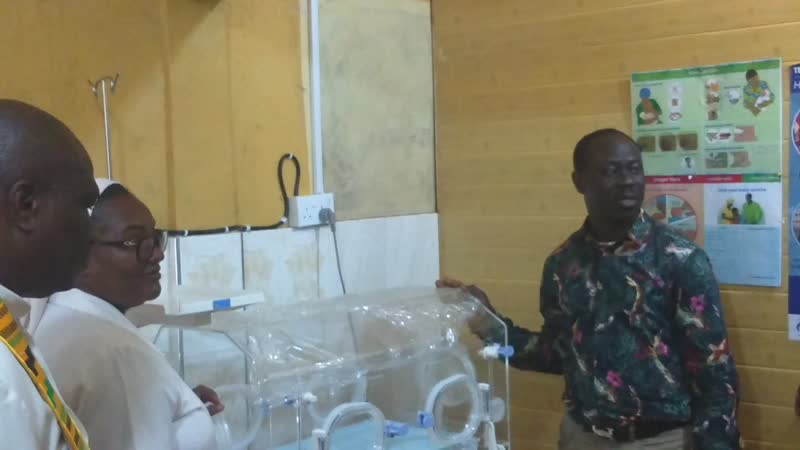
St. Joseph’s Hospital, Nkwanta in the Nkwanta South District of the Oti Region has received medical equipment including two incubators, wheel chairs valued over £10,000.00 equivalent to GH¢60,000.00 from Ghanaian Roman Catholic Church members of St. Michael and Martin Parish in the United Kingdom to help reduce neonatal deaths in the hospital.
The donation was in response to a story carried by Benjamin Owusu in which administrator of the hospital, Rev. Sister Georgina Quayson appealed for incubators for the neo-natal department.
St. Joseph’s Hospital has been without incubator since its establishment forcing management to use self-made carpenter boxes as incubator to enable them save pre-term babies.
Speaking to Voltaonlinegh after the presentation of the items to the hospital, the leader of the group, John Karikari said this was part of contributions to give back to the society and also help the government and the Ghana Health Service to reduce neonatal deaths among babies born pre-term in the country.
Mr. Karikari expressed hope that the donation would help improve neo-natal cases at the hospital and pleaded with the hospital to take good care of the incubators to serve its intended purpose.
Rev. Sister Georgina Quayson receiving the donation on behalf of management and staff, expressed her profound appreciation to the group and the media and hoped that it would be highly beneficial to the hospital.
Rev. Sister Quayson regretted that neo-natal deaths had contributed the most to child mortality at the hospital and hoped that the incubators would save lives of many pre-term babies in the municipality.
The administrator appealed to other philanthropic individuals and organisations for more support to enable the hospital complete the stalled neo-natal facility to improve healthcare delivery in the area.
Staff at the maternity department commended the donors and the reporter for the support saying that “has been an urgent need for quite a long time” and also appealed for ventilation machine to achieve desired result.
Queen mother of Tanyigbe Dzafe, Mama Hokor I has called on traditional leaders to take keen interest in the education of the youth in their immediate communities for development.
Mama Hokor noted that communities could only develop through education because well educated citizens would make informed decision which would inure to the benefit of the communities, thus, the need for traditional leaders to be involved in shaping and reshaping of the educational system.
She indicated that for children of school going age in rural areas to appreciate education and be exposed to the importance of education, traditional leaders must initiate measures including extra-curricular activities, scholarship and awards scheme and mentorship programme.
She challenged traditional leaders to change from the system where they lorded over the people in the past to a system where they would serve the people by being involved in the education of their younger generation.
Mama Hokor I made the call at this year’s “2019 Hokor Endowment Fund Scholarship Examination Programme” at Tanyigbe in the Ho Central Constituency of the Volta Region which saw 70 pupils transiting from primary six to Junior High School one (JHS 1) participate.
The Scholarship Scheme
The 70 participants from four primary schools in four communities of Tanyigbe (Tanyigbe Anyigbe, Etoe, Atidze and Dzafe) who took part in the contest were examined in Mathematics, English and General Knowledge and would have their papers marked by external examiners to determine the winners.
A ceremony will be held in October to announce and celebrate the winners. The first 10 winners will receive various packages with the first, second and third position winners expected to receive a yearly grant of GH¢200.00 for three years.
The “Hokor Endowment Fund” was established during the enstoolment of Togbe Kodzo Hokor 1I and Dr. Mama Abra Hokor I as traditional rulers of Tanyigbe Dzafe aimed at equipping every child with knowledge and skills directed at a desired future and to promote education as key to the general development of Tanyigbe.
The Hokor Endowment Fund also runs other programmes including Scholarship, Mentorship, Counselling, Rehabilitation and Exchange Programme in Tanyigbe.
Emphasis on Education
The Special Guest of Honour, Madam Grace Akuaku advised the pupils to be respectful and focus on their education in order to become the great personalities they would aspire to be in future.
Madam Akuaku, a native of Tanyigbe donated and pledged her support for the foundation and some five pupils from her village, Sosoeme in Tanyigbe Etoe should they make it to the firs-ten positions after the examination.
The Paramount Chief of Tanyigbe Traditional Area, Togbe Kodi Adiko VI commended the foundation for their support for the youth in education and assured of his support and collaboration of the Tanyigbe Traditional Council to make the awards more attractive.
Togbe Adiko advised the pupils to develop interest for education and to refrain from all social vices in order to help develop Tanyigbe.
He disclosed his intention to support pupils who would perform well in their Basic Education Certificate Examination for the next three years and hinted of other scholarship schemes to support brilliant but needy students with their education.
Gender Desk Officer, South Tongu District Assembly in the Volta Region, Hellen Dzide has appealed to chiefs and opinion leaders to support aspiring assembly women in their respective electoral areas to win the elections.
Madam Dzide said the aspiring assembly women needed the right support and encouragement in the upcoming elections to win in order to champion the cause of women/girls.
The gender desk officer said women were already disadvantaged as many assemblies barely had women assembly members, an indication that the interests of women (who are in majority in terms of population) had been neglected making mockery of good governance.
In her presentation on the advantages of women empowerment and gender equality on the individual, the family and society, she said the absence or less number of women in the local assemblies, amounted to inequality as issues relating to men would take prominence over that of women.
She spoke on Wednesday, September 11 at a day’s forum on male engagement for gender equality and development organised by Department of Gender, Volta Region with funding support from the United Nations Population Fund (UNFPA) at Bakpa, Central Tongu to deliberate on issues of unequal opportunities for men and women and proffer solutions to them.
The forum chaired by chief of Dadobe/Wute, Togbe Akliku Ahorney II concluded that boys and girls should be given equal opportunities to develop their potentials with particular attention paid to girls so that their total development (considered critical to society’s development) would not suffer due to teenage pregnancy and its attendant consequences.
District Imam, Mohammed Issah suggested that gender stereotypes be tackled from the base and called on the Ministry of Education to ensure publishers of textbooks for pupils make conscious efforts to avoid portraying girls/women as just domestic workers with men occupying important positions because such depictions only perpetuate perceptions that “women are lesser.”
Mr. Issah agreed with an earlier submission from a participant that schools must make the right changes to allow girls to compete senior/school prefect’s position (currently the sole reserve for boys) to motivate them to aspire for leadership positions in future.
According to him, these little things indirectly contributed to women’s reluctance to assume leadership roles to make meaningful contributions to society because they grew up thinking that men were best suited for such positions.
The forum which had chiefs, assembly members, religious groups, headmen and boys groups as participants was on the theme, “Well Trained Girls and Boys Make a Developed Society”.
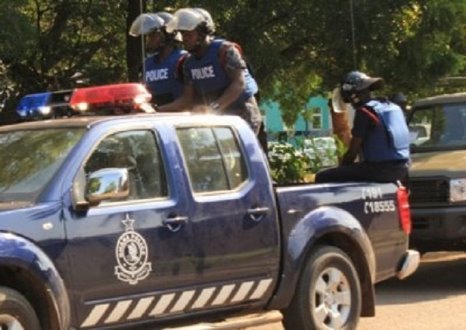
The Volta Regional Motor Transport and Traffic Department ((MTTD) of the Ghana Police Service has realised an amount of GH¢15,840.00 from fines from offending motorists within the Ho Municipality.
The Police MTTD arrested two taxi cabs, four motorbikes and 20 motorcycles for various road infractions when it intensified its operation in the municipality.
According to a release issued on Tuesday, September 11, 2019 and signed by the Public Affairs Officer, Corporal Prince Dogbatse, all 26 offending motorists were processed and arraigned before the District Magistrate Court 1 for offences including “use of tricycle without licence, use of tricycles without insurance, use of motorcycle without protective helmet, use of motor vehicle without warning device.”
The release said “23 offenders who pleaded guilty to their respective offences were sentenced to fines ranging between GH¢300.00 and GH¢900.00.”
“Three offenders were also banned from riding for one year while three other cases have been adjourned to 12 and 16 September for hearing,” it further said.
The Regional Police Command advised motorists to acquire the requisite training and rider licence, tricycle riders in particular, before riding on the road saying, “it is our resolve to protect life and property of our road users.”
An official from Ghana Health Service, Central Tongu District in the Volta Region, Dzifa Asempa has suggested surcharging people to help reduce teenage pregnancy and keep girls in school.
Madam Asempa lamented the staggering statistics of teenage pregnancy in the region and its attendant implications such as Vesico-vagina Fistula and death for the girls and burden and loss of human resource to society saying, steps must be taken to reduce the trend and reposition Volta Region as leader in producing well educated and prominent citizens.
She said child bearing must be for adults only and men/boys who would get girls pregnant must be made to pay unreasonable charges to deter others.
According to her, she learnt that a similar policy was implemented in a community in the Adaklu District where teenage pregnancy was on the rise and it yielded good results.
“Let’s follow the Adaklu example and force men who will impregnate teenagers to pay huge fines. I will appeal to the chiefs and headmen to take this up. This should not be the normal tradition of people bringing in few drinks and others to own pregnancies they are responsible for but more to serve as deterrent to such men and reduce the rate of girls becoming pregnant.”
She spoke about intervention programmes in the district which involved the assembly, the district offices of health and education, queens and chiefs organising workshops on the phenomenon among others in 2017 which helped matters but stalled due to financial constraints saying, it was important other ways were devised to help arrest the situation.
Apart from surcharging, Madam Asempa called on people to welcome family planning for sexually active teenagers to forestall the possibility of them becoming pregnant multiple times and preventing them from fully developing their potentials.
She gave the suggestion during a presentation on the status of teenage pregnancy/child marriage in the district and its consequences on the individual, the family and the society at a day’s forum on male engagement for gender equality and development held at Sun City Gardens, Bakpa, Central Tongu.
Wednesday’s forum themed “Well Trained Girls and Boys Make a Developed Society” organised by Department of Gender, Volta Region with funding support from the United Nations Population Fund (UNFPA), had participants discuss issues relating to the vulnerability of women in the male-dominated world and how to empower them.
The men, who admitted there was the need for change of mindset, agreed that the empowerment process must begin right from the home during the socialization process by giving both boys and girls equal opportunities to do away with gender stereotypes.
Volta Regional Director, Department of Gender, Lena Alai underscored the need for the forum and said men/boys had a major role to play in reducing teenage pregnancy.
Madam Alai said “teenage girls have taken child bearing from adults” citing the Multiple Indicator Cluster Survey Report of 2017/18 which revealed that Volta Region recorded the highest adolescent birth rate in the country with Central Tongu coming fourth in the region.
The forum chaired by chief of Mafi-Dadobe/Wute, Togbe Akliku Ahorney II and attended by chiefs, assembly members, religious groups, headmen, and boys groups also saw UNFPA Focal Person at the Volta Regional Coordinating Council, Victoria Odurowa Fato in attendance for monitoring purpose.